
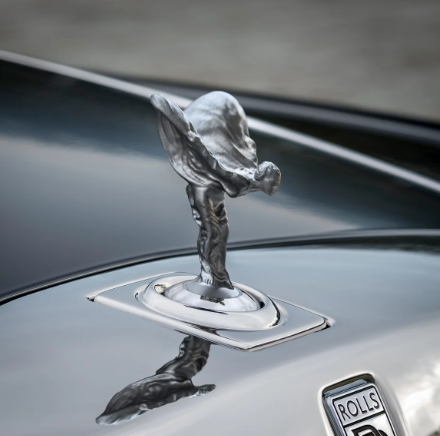
From Personal Sculpture to Brand Symbol
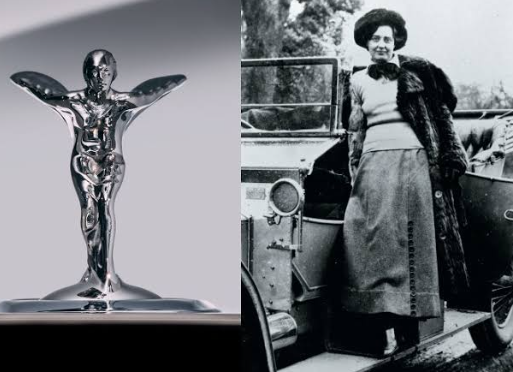
The formation of Rolls Royce Spirit of Ecstasy was not a simple car logo design, but rather a process of gradually evolving from a custom-made sculpture into a brand symbol. Its precursor is often attributed to a small hood sculpture called “The Whisper.” That work, modeled after a female figure with her finger lightly touching her lips, conveyed a sense of intimacy, subtlety, and commemoration. Later, Rolls Royce needed a more unified hood ornament that better represented the brand spirit, and sculptor Charles Sykes redesigned the original figure.
This is also a crucial design starting point for Rolls Royce Spirit of Ecstasy: it didn’t begin with geometric shapes or lettering, but with a human sculpture. The designer’s problem wasn’t just “how to make a car logo,” but “how to express the essence of the car brand with a three-dimensional figure.” Therefore, from the outset, it possessed the triple attributes of sculpture, narrative, and brand identity.
How to Express “Quiet Speed” in Design
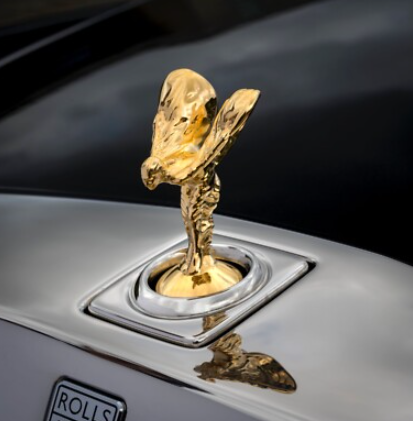
The core design concept of the Spirit of Ecstasy is to transform the sense of speed into an elegant posture. While the car itself represents mechanical power, Rolls-Royce is not suited to exaggerated symbols of power. What’s needed is a quiet, restrained, and composed sense of progress. Therefore, the figure is designed with a slight forward lean, arms outstretched, and robes extending from the arms and back, forming silhouettes resembling wings and airflow.
This design is ingenious. The forward-leaning body provides a sense of direction, the backward-flowing robes represent the presence of wind, while the overall posture avoids exaggerated movements of running or flying. In other words, it doesn’t directly express speed, but rather “the form left by speed passing through the body.” This design language is closer to kinetic capture in sculpture: the figure itself is still, but the lines give the viewer the feeling that it is moving forward.
Contour Recognition and Front Proportions
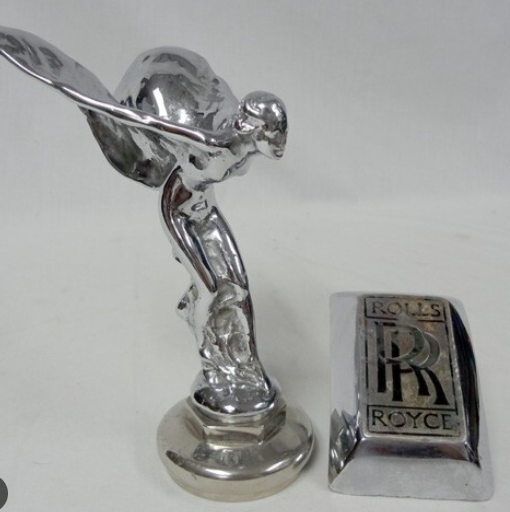
As a front-end decoration, the Rolls-Royce Spirit of Ecstasy had to meet a very practical design requirement: it had to maintain clear recognizability within a very small size. Unlike large sculptures that rely on intricate details, a car hood ornament needs to be clearly visible from a distance, at different angles, and under different lighting conditions. Therefore, the design focus is not just on facial details, but on the overall silhouette.
The figure’s head, forward-leaning body, outstretched arms, and flowing robes create a stable silhouette. Even viewed from the side, its forward momentum is palpable; from the front, the robes form a nearly symmetrical unfolding structure, lending the small sculpture a sense of ceremony. The base needs to seamlessly integrate with the lines of the car’s front end, avoiding any abruptness. A good hood ornament is not about forcibly placing a sculpture on the car, but about making it an integral part of the visual order of the front end.
Materials, Craftsmanship, and Design Spirit
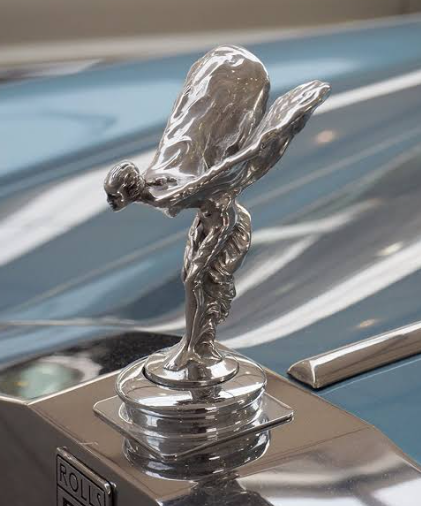
The design value of “Royce Spirit of Ecstasy” is also reflected in its materials and craftsmanship. Early car hood ornaments needed to balance intricate detail, durability, and surface texture; therefore, metal was ideal for this type of small, three-dimensional emblem. Metal can present clearly defined edges of clothing folds and also create a stable and refined visual focal point at the front of the car.
If this image were transformed into a large sculpture, the design logic would change. Small car hood ornaments emphasize precision and recognizability, while large sculptures prioritize spatial awareness, structural stability, and viewing angle. Bronze is suitable for expressing a sense of history and classic elegance, while stainless steel is better suited to modern architectural spaces, especially with its mirror-polished finish, which allows the sculpture to reflect its surroundings. Here, the original symbol of the automobile is amplified, becoming a spatial expression of speed, luxury, and modern industrial aesthetics.
Why it’s a successful design case
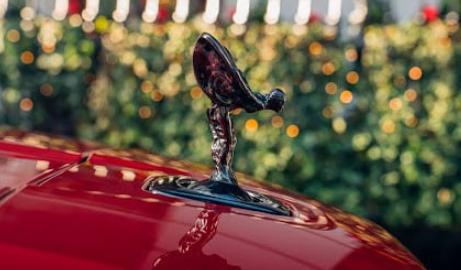
The success of Rolls Royal Spirit of Ecstasy isn’t just because it belongs to a famous car brand, but also because it solved several key design problems: how to embody the brand spirit, how to make a static object convey a sense of movement, how to make a small sculpture highly recognizable, and how to unify the decorative elements with the product itself.
It doesn’t rely on complex patterns, but rather on posture, proportion, and contour to create memorability. The figure leans forward but not hastily, the robes are spread but not cluttered, and the overall effect is elegant yet directional. This balance allows it to exist both as a car logo and as a standalone sculptural work.
From a design perspective, Rolls Royce Spirit of Ecstasy is a prime example: truly classic visual symbols are rarely simply “drawn,” but rather gradually formed through storytelling, function, materials, proportions, and spatial relationships. Standing at the very front of the car, it’s not merely decorative; rather, it uses a tiny, three-dimensional image to express the brand’s understanding of speed, tranquility, and luxury.